APOSTLE
arrow_back AI Video Production Pipeline
Module 03 Multi-Model Routing

Multi-Model Routing — Which AI Video Tool for Which Shot

Learn how to choose the right AI video generation model for each shot type, combining outputs from Veo, Kling, Runway, and Sora into a cohesive final video.

schedule 15 min
signal_cellular_alt Intermediate
menu_book Lesson 03 of 6

Estimated time: 15 minutes What you'll learn: How to choose the right AI video generation model for each specific shot type — the core professional skill that separates one-tool amateurs from multi-tool producers. Tools used: Veo 3.1, Kling 2.6/O1, Runway Gen-4.5, Sora 2 (conceptual comparison)


Learning Objectives

By the end of this module, you will be able to:

  • Identify the specific strengths and weaknesses of each major AI video model
  • Route shots in a project to the optimal tool based on shot requirements
  • Combine outputs from multiple tools into a cohesive final video
  • Make cost-effective routing decisions based on budget constraints

Why Multi-Model Routing Matters

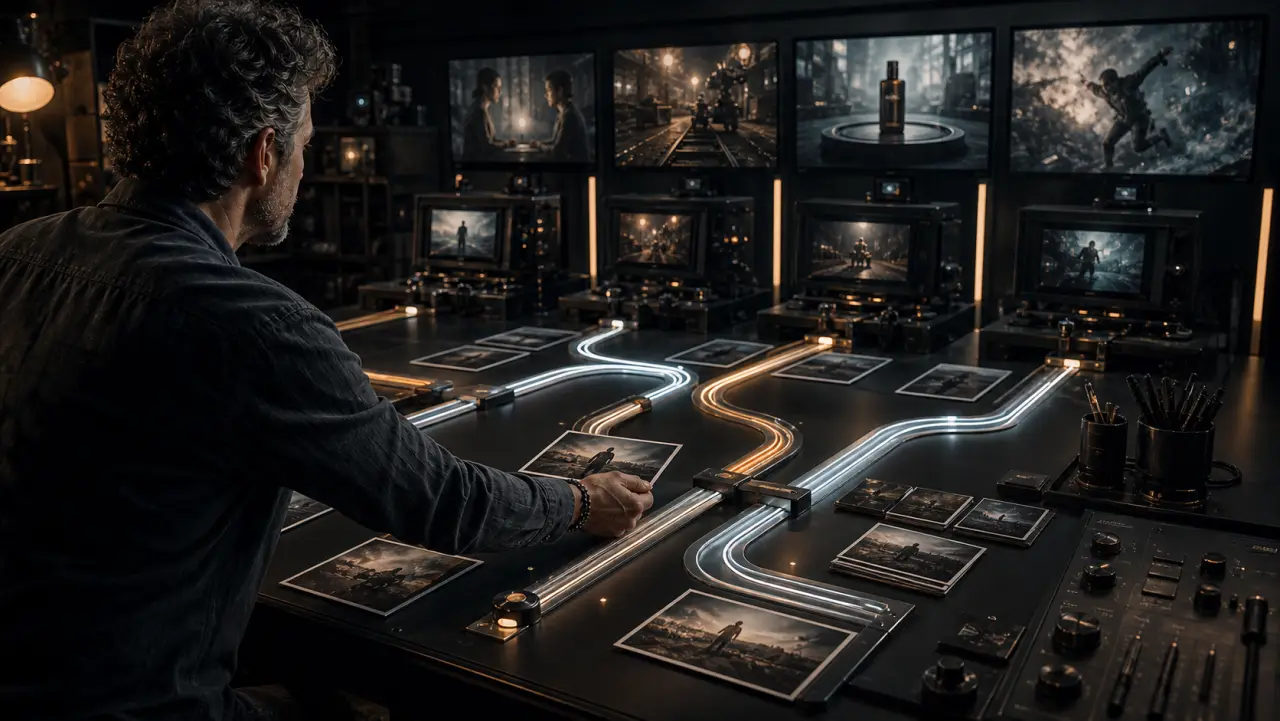
No single AI video tool is best at everything. Kling has the best camera control. Veo produces the most cinematic output with native audio. Runway excels at creative style transfer and effects. Sora handles physics and narrative coherence uniquely.

Professional AI video producers use 2-4 tools on every project, routing each shot to the model that handles that specific shot type best. This is multi-model routing — and it's the skill that most dramatically improves output quality.

Think of it like a film studio using different camera systems: an ARRI Alexa for dramatic scenes, a RED for action sequences, and a Sony FX6 for documentary-style coverage. Same project, different tools for different needs.


The Big Four: Strengths & Weaknesses at a Glance

Veo 3.1 (Google DeepMind)

Where it dominates:

  • Cinematic visual quality — consistently produces the most "filmic" output
  • Native synchronized audio — dialogue, SFX, and ambient sound generated with video
  • Character consistency via the Ingredients system (reference images lock identity)
  • Long-duration clips (up to 8 seconds at high quality)
  • Understanding of physical world interactions

Where it struggles:

  • Less precise camera control than Kling — you describe movement, it interprets
  • Can be overly "Google-clean" — sometimes lacks grit
  • Slower generation times
  • API-only access outside of Google Flow (no simple web UI for advanced features)

Best for these shot types:

  • Hero/beauty shots requiring cinematic polish
  • Dialogue scenes with synchronized lip movement
  • Establishing shots with atmospheric audio
  • Character-driven emotional moments
  • Scenes requiring complex physics (water, fabric, smoke)

Prompt structure for Veo 3.1:

Google's official guidance recommends structuring prompts with four elements:

[Camera movement and framing] + [Scene/environment description] +
[Subject action and appearance] + [Atmosphere, mood, and style]

Example:

A slow tracking shot follows a woman in a cream linen jacket walking through
a sun-dappled European alleyway. Cobblestone street, ivy-covered walls,
warm afternoon light. She pauses to look at a flower shop display, touching
a rose gently. Cinematic, warm color grading, shallow depth of field,
shot on 35mm film. Ambient sounds of distant conversation and birdsong.

Kling 2.6 / Kling O1 (Kuaishou)

Where it dominates:

  • Most precise camera control of any AI video model — dolly, crane, orbit, zoom with exact specifications
  • Element Library (O1) — upload character/object references that persist across generations
  • Simultaneous audio-visual generation (2.6+)
  • Speed — fast generation times, good for iteration
  • Motion brush — paint specific motion paths on still images
  • Best for product videos requiring precise object movement

Where it struggles:

  • Output can lack the "cinematic feel" of Veo — more commercially polished than artistically refined
  • Character faces can drift in longer clips
  • Less natural dialogue lip sync than Veo
  • Motion physics occasionally breaks (limbs bending unnaturally)

Best for these shot types:

  • Product shots requiring precise camera orbits
  • Action sequences with specific choreographed movement
  • Shots requiring exact camera paths (dolly, crane, Steadicam)
  • Quick iterations and tests (fast generation)
  • Close-ups with controlled micro-movements

Camera control syntax for Kling:

Kling offers 1,296 camera lens combinations. Key movement types:

Camera Movement Options:
- Dolly in / Dolly out (forward/back)
- Truck left / Truck right (side-to-side)
- Pedestal up / Pedestal down (vertical)
- Pan left / Pan right (rotation on axis)
- Tilt up / Tilt down
- Orbit left / Orbit right (around subject)
- Crane up / Crane down
- Zoom in / Zoom out
- Rack focus (foreground ↔ background)
- Boltcam (high-speed sweep)

Runway Gen-4.5

Where it dominates:

  • Creative effects and style transfer — the most "artistic" of the video models
  • References system — upload style/character/environment references for consistency
  • Green Screen mode for compositing
  • Extend feature for lengthening existing clips
  • Acts — multi-shot scene continuity features
  • Best ecosystem of creative tools (image gen, training, text effects)

Where it struggles:

  • Less photorealistic than Veo or Kling for straight live-action style
  • Camera control less precise than Kling
  • Native audio generation less mature
  • Can produce "dream-like" motion that doesn't match live-action footage

Best for these shot types:

  • Stylized or artistic content (music videos, fashion films, mood pieces)
  • Green screen / compositing elements
  • Style transfer from reference images to video
  • Extending or modifying existing clips
  • Abstract/experimental visual effects

Sora 2 (OpenAI)

Where it dominates:

  • Physics simulation — the most realistic object interactions (gravity, collisions, fluids)
  • Narrative coherence over longer clips
  • Understanding of real-world causality (if X happens, Y naturally follows)
  • Natural human movement and body dynamics

Where it struggles:

  • Less artistic control than competitors — it interprets rather than executes precise direction
  • Character consistency across separate generations
  • Less mature camera control system
  • Limited availability and higher cost

Best for these shot types:

  • Scenes requiring realistic physical interactions
  • Dynamic action with natural momentum
  • Narrative sequences where cause-and-effect matters
  • Simulated documentary-style footage

The Routing Decision Framework

For each shot in your project, answer these three questions:

Question 1: What is the shot type?

Shot Type Primary Tool Why
Dialogue scene with lip sync Veo 3.1 Best native audio-visual sync
Product orbit / tabletop Kling 2.6 Most precise camera rotation control
Cinematic establishing shot Veo 3.1 Best atmospheric quality + ambient audio
Action sequence with choreography Kling O1 Motion brush + precise camera paths
Stylized / artistic mood piece Runway Gen-4.5 Best creative style transfer
Physical interaction (pouring, breaking, flowing) Sora 2 or Veo 3.1 Best physics simulation
Quick social media clip Kling 2.6 Fastest generation for iteration
Character close-up emotional beat Veo 3.1 Most cinematic facial rendering
Product demo with text overlays Kling 2.6 Better text handling + precise movement
Abstract visual / title sequence Runway Gen-4.5 Creative effects and style transfer

Question 2: Does the shot need audio?

If the shot needs synchronized dialogue, sound effects, or ambient audio generated WITH the video:

  • Veo 3.1 — best native audio-visual synchronization
  • Kling 2.6 — simultaneous audio generation (good but less refined)

If audio will be added in post-production:

  • Any tool works — route based on visual requirements instead

Question 3: What's the budget/speed constraint?

Constraint Recommended Approach
Maximum quality, no budget limit Veo 3.1 for hero shots, Kling for precise camera work
Fast turnaround, good quality Kling 2.6 for everything (fastest generation)
Free tier only Kling (generous free tier), Runway (limited free), Veo (via Gemini app free tier)
High volume (20+ clips) Kling for bulk, Veo for hero shots only

Real-World Routing: The Coffee Commercial Example

Returning to our coffee brand commercial from Module 2, here's how a professional would route each shot:

SHOT 1 — Hands pouring coffee, overhead close-up, 4s
→ KLING 2.6
Why: Precise control over hand movement and camera angle.
Product-focused with specific object interaction.
Camera: Static overhead with subtle zoom.
Audio: Added in post (pouring SFX from library).

SHOT 2 — Maya picks up mug, medium shot, 3s
→ VEO 3.1
Why: Character-driven moment requiring cinematic facial rendering.
Camera: Medium shot, slight dolly left.
Audio: Native — ambient morning kitchen sounds.
Ingredient: Maya's headshot uploaded as reference for consistency.

SHOT 3 — Maya walks to window, tracking shot, 5s
→ VEO 3.1
Why: Complex tracking movement + character consistency needed.
Longest shot requiring sustained quality.
Camera: Full body tracking shot.
Audio: Native — piano music + ambient city sounds.
Ingredient: Same Maya reference, living room environment reference.

SHOT 4 — Product shot on marble, 3s
→ KLING 2.6
Why: Product precision. Static shot with only steam movement.
Camera: 45-degree, shallow DOF, completely static.
Audio: Added in post (music continues from shot 3).

SHOT 5 — Brand end card, 2s
→ AFTER EFFECTS (traditional)
Why: Logo animation with exact brand specifications.
Not an AI generation task.

Notice the pattern: Kling handles the precise, product-focused, controlled shots. Veo handles the cinematic, character-driven, emotionally resonant shots. This is the most common routing split in professional AI video production.


Handling Cross-Tool Consistency

The biggest challenge with multi-model routing is maintaining visual consistency when different tools generate different shots. Here's how to manage it:

1. Color Consistency AI video tools have different default color profiles. Veo tends cooler and more cinematic. Kling tends more saturated and commercial. Runway tends more stylized.

Solution: Plan for color grading in post-production (Module 6). Shoot a "grey card" equivalent — generate a simple solid-color reference in each tool to understand its color bias. Grade everything to match in DaVinci Resolve.

2. Character Consistency Each tool's reference/ingredient system produces slightly different interpretations of the same character.

Solution: Use the exact same keyframe image as the input for image-to-video generation across all tools. The keyframe IS your consistency anchor — it already contains the correct character, environment, and composition.

3. Motion Quality Tools produce movement at different "speeds" — Veo motion feels more deliberate, Kling can feel snappier.

Solution: Use speed ramping in post to match pace across clips. Slight slow-motion (80-90% speed) on faster clips can unify the feel. Plan shot duration to allow for trimming.

4. Resolution and Aspect Ratio Some tools output at different native resolutions.

Solution: Generate everything at the highest available resolution. Crop and resize in post rather than during generation. Lock aspect ratio in your shot list.


Cost Comparison (March 2026)

Tool Free Tier Paid Plan Cost per Minute (est.)
Veo 3.1 Via Gemini app (limited) $20/mo Google AI Pro, or API pricing ~$0.50-2.00/min via API
Kling 2.6 66 credits/day $8-66/mo ~$0.30-0.80/min
Runway Gen-4.5 125 credits free $12-76/mo ~$0.50-1.50/min
Sora 2 Via ChatGPT Plus $20-200/mo ~$1.00-3.00/min

For a 30-second video with 4-5 shots (generating 3-5 takes per shot), expect to spend 50-200 credits across tools, or roughly $5-30 in API costs.


Practical Exercise

Exercise: Route a Real Project

Take the video you analyzed in Module 1's exercise (the 15-30 second ad you decomposed). Now:

  1. List every shot with its key requirements (camera movement, subject action, audio needs)
  2. Route each shot to one of the Big Four tools using the decision framework
  3. Justify each routing decision in one sentence (e.g., "Kling because this needs a precise 360° product orbit")
  4. Identify consistency risks — which shots might look different from each other? How would you mitigate this?
  5. Estimate the cost of generating this project across tools

This is the most important planning exercise in the course. In professional production, routing decisions are made in pre-production — not discovered mid-generation.


Key Takeaways

  • No single AI video tool is best at everything. Professional production uses 2-4 tools per project.
  • Veo 3.1 excels at cinematic quality and native audio. Use it for hero shots, dialogue, and emotional beats.
  • Kling 2.6/O1 offers the most precise camera and motion control. Use it for product shots, choreographed movement, and fast iteration.
  • Runway Gen-4.5 is strongest for creative and stylized content. Use it for artistic effects, style transfer, and compositing elements.
  • Route decisions are made in pre-production, based on shot requirements — not by defaulting to whichever tool you know best.
  • Cross-tool consistency is managed through shared keyframes (same start image across tools) and post-production color grading (Module 6).

References & Resources


Next up: Module 4: Generation Mastery — Image-to-Video with Professional Controls →

Copied to clipboard