APOSTLE
arrow_back AI Video Production Pipeline
Module 06 Post-Production

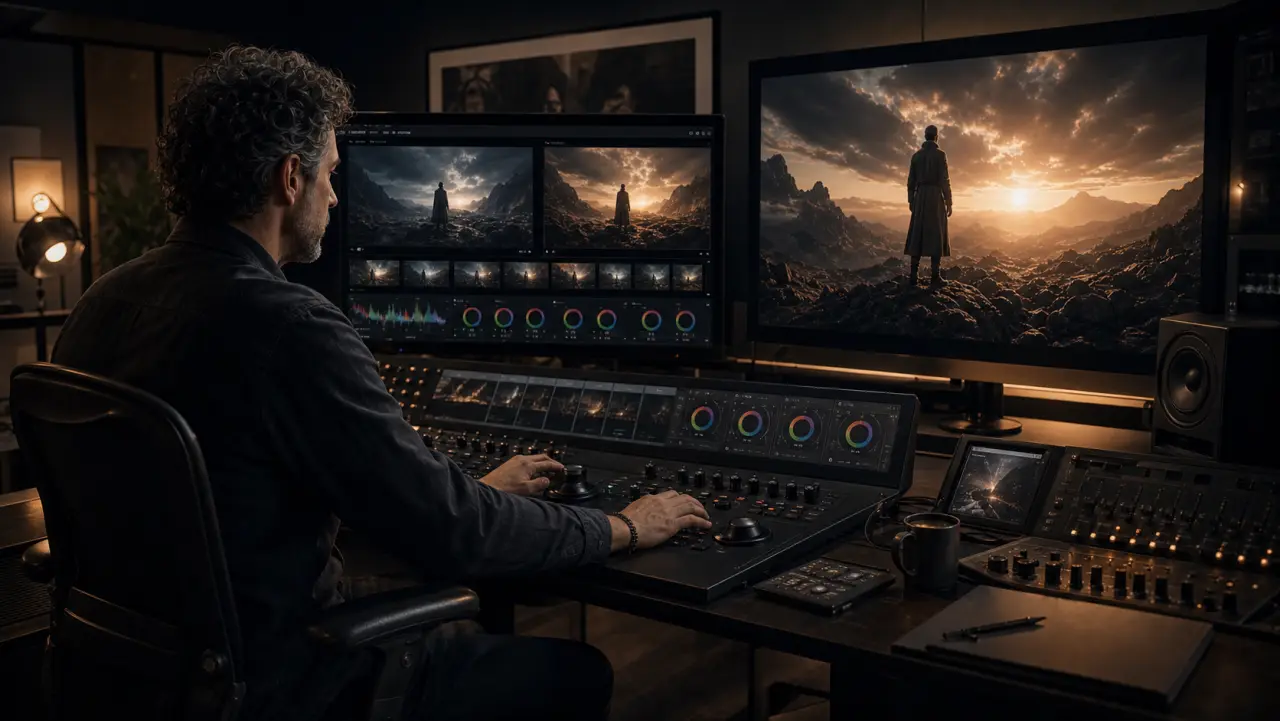
Post-Production — AI Clips to Final Delivery

Take raw AI-generated clips into a professional NLE for editing, color grading, audio mixing, and multi-platform export to deliver polished final video.

schedule 15 min
signal_cellular_alt Intermediate
menu_book Lesson 06 of 6

Estimated time: 15 minutes What you'll learn: How to take raw AI-generated video clips and audio into a professional NLE, then color grade, composite, mix audio, and export for delivery. Tools used: Adobe Premiere Pro / DaVinci Resolve, Color.io (optional)


Learning Objectives

By the end of this module, you will be able to:

  • Import and organize AI-generated clips in Premiere Pro or DaVinci Resolve
  • Identify and fix common visual artifacts in AI-generated footage
  • Color grade AI footage for cross-tool consistency and professional polish
  • Mix layered audio (dialogue, music, SFX, ambient) to broadcast standards
  • Export in multiple format specifications for different delivery platforms

Why Post-Production Is Non-Negotiable

AI-generated clips are raw material, not finished products. Even the best AI video output needs post-production for three reasons:

1. Cross-tool consistency. If you used Kling for shot 1 and Veo for shot 2, they'll have different color profiles, contrast levels, and motion characteristics. Color grading unifies them into a cohesive visual language.

2. Pacing and storytelling. AI generates clips of fixed duration. Professional video lives and dies by its editing rhythm — the timing of cuts, the breathing room between moments, the acceleration toward a climax. This is editorial craft, not generation.

3. Polish and detail. Removing AI artifacts, adding transitions, layering audio, inserting text/graphics, and adjusting timing all happen in post. The difference between "AI-generated content" and "a video" is this stage.


Step 1: Import and Organize

Create a project structure in your NLE that mirrors your production bible:

Project: Origin Coffee Commercial
├── 01_Source_Clips/
│   ├── Shot_01_Take_03.mp4   ← Selected best take
│   ├── Shot_02_Take_01.mp4
│   ├── Shot_03_Take_04.mp4
│   └── Shot_04_Take_02.mp4
├── 02_Audio/
│   ├── Music_Piano_30s.wav
│   ├── VO_Begin_With_Better.wav
│   ├── SFX_Coffee_Pour.wav
│   ├── SFX_Birdsong.wav
│   └── AMB_Morning_Kitchen.wav
├── 03_Graphics/
│   ├── Origin_Logo.png
│   ├── End_Card.psd
│   └── Lower_Third.mogrt
├── 04_Reference/
│   ├── Color_Ref_Image.png
│   └── Edit_Reference_Video.mp4
└── 05_Exports/

Sequence settings for AI video:

Most AI video tools output at 24fps. Set your timeline to match. If you need 30fps delivery, import at native 24fps and interpret/conform in the export settings — don't re-interpret the footage to 30fps on import, as this creates motion artifacts.

Recommended sequence settings:
- Resolution: 1920×1080 (or match your highest-res footage)
- Frame rate: 24fps (match source — do NOT mix frame rates)
- Codec: ProRes 422 (timeline) or H.264 (if storage-constrained)
- Color space: Rec. 709 (standard delivery) or Rec. 2020 (HDR)

Step 2: The Rough Cut

Lay out your selected takes in sequence order. This is the "assembly edit" — every shot in order, at full length, no trimming.

Then begin trimming. AI video clips often have usable sections in the middle — the first and last 0.5-1 seconds frequently contain generation artifacts (warping, flickering, or motion settling). Trim these off.

AI-specific editing considerations:

  • Trim generation artifacts: The first 0.3-0.5s and last 0.3-0.5s of AI clips often contain startup/settling artifacts. Cut these.
  • Use dissolves sparingly: Cross-dissolves can mask minor inconsistencies between shots, but overuse makes the edit feel amateur. Use cuts as your primary transition.
  • Speed ramp to unify motion feel: If Kling clips feel "snappier" than Veo clips, slow down Kling footage to 85-90% to match Veo's more deliberate motion quality.
  • Freeze frames for holds: If you need a moment to last longer than the generated clip, freeze the last clean frame and hold for 0.5-1s before cutting. This works well at emotional beats.
  • Reverse clips for variety: AI clips often play well in reverse, giving you additional shot options without regenerating.

Step 3: Color Grading for Consistency

This is the most important post-production step for multi-tool AI video. Each AI model has a different default color profile:

Color biases by tool:
- Veo 3.1:     Slightly cool, high dynamic range, cinematic contrast
- Kling 2.6:   Slightly warm, saturated, commercial feel
- Runway:      Varies heavily by generation, often stylized
- Sora 2:      Neutral to warm, natural contrast

Three-step color grading workflow:

Step A: Normalize. Before applying any creative grade, bring all clips to the same baseline. In DaVinci Resolve, use the Color Match tool or manually adjust lift/gamma/gain to match exposure and white balance across all clips. In Premiere Pro, use Lumetri Color → Basic Correction.

The goal: every clip should have the same brightness, contrast, and white point BEFORE you add style.

Normalization checklist:
□ White balance matched across all clips (check a white/grey element)
□ Exposure levels matched (check histogram — peaks should align)
□ Contrast ratio similar (blacks and whites at similar levels)
□ Skin tones consistent (use vectorscope — skin falls on the warm line)

Step B: Creative grade. Apply your project's color identity. This is where the hex codes from your color palette (Module 2) come back into play.

For the coffee commercial's warm, morning aesthetic:

  • Push shadows toward warm amber (not blue)
  • Lift midtones slightly for an airy feel
  • Desaturate slightly (85-90% saturation) to avoid the "AI hyper-color" look
  • Add a subtle warm tint to highlights

Step C: Film look. AI footage can look "too digital" — perfectly clean in a way real video never is. Adding analog texture sells the realism.

Elements to add:

  • Film grain: Subtle grain (2-5% intensity) breaks up the digital smoothness. Use built-in grain effects or overlays.
  • Subtle vignette: Darkened corners (10-15% intensity) draws focus to center frame.
  • Slight halation: A very subtle glow on highlights mimics how light behaves on film.
  • Contrast curve: Pull down the top of the RGB curve slightly — this prevents pure whites, giving the image a more filmic ceiling.

Tool recommendation: Color.io — an AI-powered color grading tool that applies analog film emulation. Upload an AI clip, select a film stock emulation (Kodak Portra, Fuji, CineStill), and it applies a physically-accurate grade. Particularly useful for batch-grading multiple AI clips to the same film look.


Step 4: Audio Mixing

Layer your audio tracks following the stack from Module 5. In your timeline, set up dedicated tracks:

Track layout (top to bottom):
V1: Video clips
A1: Dialogue / Voiceover
A2: Sound Effects
A3: Foley
A4: Music
A5: Ambient / Room Tone

Mixing to broadcast standards:

Target levels:
- Dialogue:    -6 to -3 dB peak, -12 dB average (LUFS)
- Music:       -18 to -12 dB under dialogue, -6 dB solo
- SFX:         -12 to -6 dB (peaked to action, not constant)
- Ambient:     -24 to -18 dB (barely perceptible, fills silence)
- Overall mix: -14 to -16 LUFS (broadcast) or -12 to -14 LUFS (social)

Transitions between audio elements:

  • Music should fade in over 1-2 seconds, not start abruptly
  • When dialogue begins, automate music volume down by 6-12 dB
  • Ambient/room tone should be present in every scene — it's the "glue" that makes edits feel continuous
  • Cross-fade ambient tracks when cutting between locations

Fixing native AI audio issues:

Native AI audio sometimes has artifacts — metallic resonance, unnatural reverb, or volume inconsistencies. Quick fixes:

  • EQ out metallic resonance: Narrow notch filter at the problem frequency (often 2-4kHz)
  • Add light compression: Even out volume inconsistencies (ratio 2:1, threshold -12dB)
  • Replace problem sections: If a 1-second segment of native audio has artifacts, cut it and replace with library audio or room tone

Step 5: Export for Delivery

Different platforms require different specifications. Here are the current optimal export settings:

PLATFORM EXPORT SPECS (March 2026):

YouTube / Website Hero:
- Codec: H.264 or H.265
- Resolution: 3840×2160 (4K) or 1920×1080 (1080p)
- Frame rate: 24fps or 30fps
- Bitrate: 35-68 Mbps (4K) or 16-24 Mbps (1080p)
- Audio: AAC, 320kbps, stereo
- Aspect ratio: 16:9

Instagram Feed:
- Resolution: 1080×1350 (4:5 portrait)
- Frame rate: 30fps
- Duration: up to 60 seconds
- Bitrate: 8-12 Mbps
- Audio: AAC, 128kbps

Instagram Reels / TikTok / YouTube Shorts:
- Resolution: 1080×1920 (9:16 vertical)
- Frame rate: 30fps
- Duration: up to 90 seconds
- Bitrate: 8-12 Mbps
- Audio: AAC, 128kbps

LinkedIn:
- Resolution: 1920×1080 (16:9) or 1080×1080 (1:1)
- Frame rate: 30fps
- Duration: up to 10 minutes
- Bitrate: 8-12 Mbps

Client Delivery (Master):
- Codec: ProRes 422 HQ (Mac) or DNxHR HQ (Windows)
- Resolution: Highest available
- Frame rate: 24fps
- Full quality, no compression artifacts

Multi-format export strategy:

Edit once at the widest aspect ratio (usually 16:9), then create alternate versions by reframing for 4:5, 9:16, and 1:1. Most NLEs have auto-reframe tools. Review every reframed version — auto-reframe can miss the mark on composition-critical shots.


The Complete Pipeline: End-to-End Recap

Here's the full pipeline you've learned across all 6 modules, applied to a real project:

MODULE 1 — UNDERSTAND THE PARADIGM
You know: AI video = Prepare → Generate → Finish (not text-to-video)

MODULE 2 — PREPARE YOUR INGREDIENTS
You've created: Script, character refs, environment refs, keyframes, audio plan

MODULE 3 — ROUTE YOUR SHOTS
You've decided: Shot 1 → Kling, Shot 2 → Veo, Shot 3 → Veo, Shot 4 → Kling

MODULE 4 — GENERATE YOUR CLIPS
You've generated: 3-5 takes per shot, selected the best, iterated on failures

MODULE 5 — PRODUCE YOUR AUDIO
You've created: Dialogue (ElevenLabs), music (Suno), SFX plan, ambient plan

MODULE 6 — FINISH IN POST
You've done: Edit, color grade, audio mix, export for all platforms

Total time for a 30-second commercial: 7-12 hours Total cost: $20-50 in AI tool credits + NLE subscription Traditional equivalent: $10,000-30,000 and 2-4 weeks

That's the professional AI video pipeline. Not magic. Not luck. A structured process that produces consistent, client-ready results.


Practical Exercise

Exercise: Complete Post-Production on Your Generated Clip

Take the clip you generated in Module 4's exercise and:

  1. Import into Premiere Pro or DaVinci Resolve
  2. Trim the first and last 0.5 seconds
  3. Apply a basic color correction (white balance, exposure)
  4. Apply a simple creative grade (warm or cool shift matching your project's mood)
  5. Add a subtle film grain overlay
  6. Layer in a 5-second music bed from Suno (generate one if you haven't)
  7. Export at 1080p, 24fps, H.264

This doesn't need to be perfect. The goal is to experience the complete pipeline end-to-end — from keyframe to finished, graded, audio-mixed clip.


Key Takeaways

  • Post-production is where AI clips become professional video. Raw AI output is raw material — not a finished product.
  • Color grading is the most important post step for multi-tool productions. Normalize first (match exposure/white balance), then apply creative grade, then add film texture.
  • AI footage benefits from analog imperfections — film grain, vignette, and slight desaturation combat the "too clean" digital look.
  • Audio mixing follows the 5-track stack: dialogue, SFX, foley, music, ambient. Each at calibrated levels.
  • Export for every platform from a single timeline using reframing — don't regenerate video for different aspect ratios.

What's Next: From Free Course to Professional Services

You've now learned the complete AI video production pipeline — the same methodology our team at Apostle.io uses to produce video for brands and agencies.

If you've followed along and completed the exercises, you can now:

  • Plan and prepare a professional AI video project
  • Route shots to the right tools
  • Generate and select quality clips
  • Produce synchronized audio
  • Finish in post-production to delivery standard

Two paths forward:

Path A: Build your own capability. Keep practicing. Take on small projects. Build a portfolio. The skills in this course are genuinely in demand — companies pay $75-200/hour for professionals who can execute this pipeline.

Path B: Let us handle it. If you're a brand, agency, or marketing team that needs AI video production at scale but doesn't want to build the in-house capability, that's exactly what Apostle.io does. We're an AI-native production studio — we combine the craft sensibility of boutique production with the efficiency of AI tools.

Explore Apostle.io's Services →

Either way, you're now equipped with the mental model that 95% of people working with AI video don't have. Use it well.


References & Resources


Course Complete

Congratulations — you've finished AI Video Production: The Professional Pipeline.

Share your work: Tag @apostle.io on social media with your completed exercise outputs. We feature the best student work in our community.

Continue learning: Check out our other free courses at apostle.io/learn:

  • Google's AI Creative Suite: Nano Banana Pro + Veo 3 + Flow
  • AI Video Ads That Convert
  • Character Consistency Across AI Tools
  • AI Filmmaking 2026: Multi-Shot Narratives
Copied to clipboard