
APOSTLE
arrow_back Character Consistency Across AI Tools
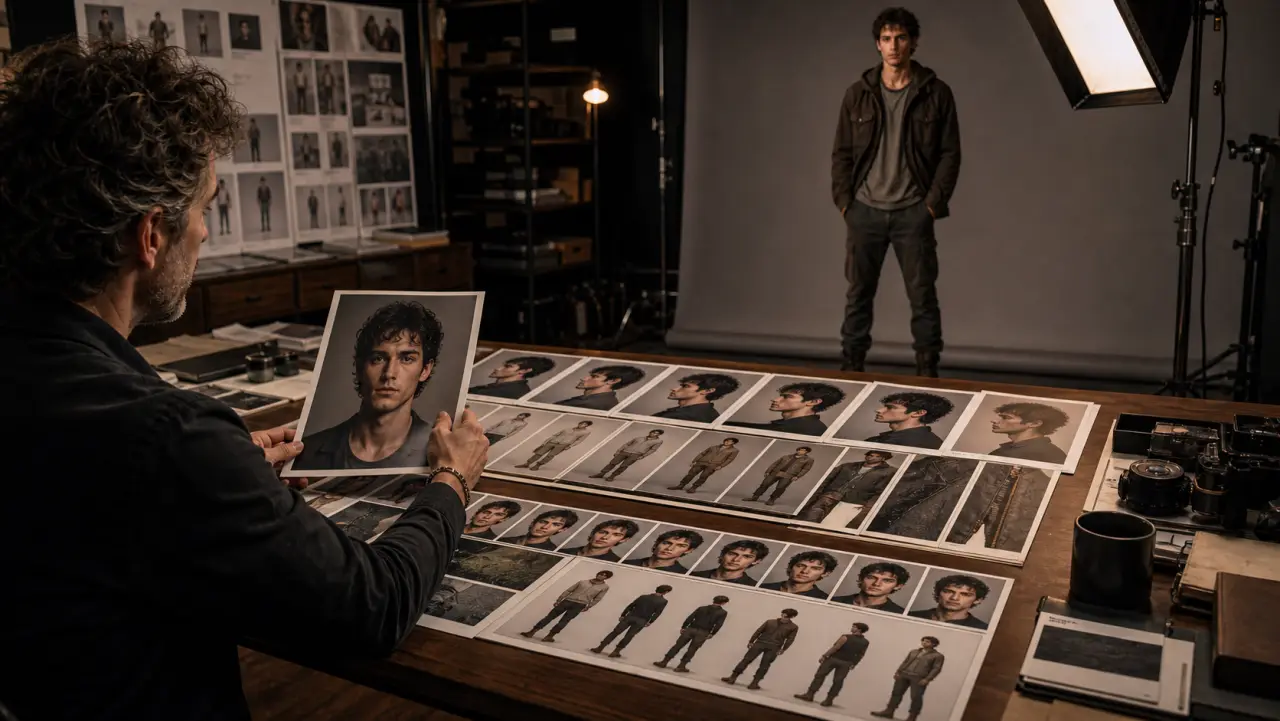
Module 02 Character Reference Packages

Building Bulletproof Character References

How to create the 6-image reference package and Identity Header that serve as your character's identity anchor across every tool and every generation.

schedule 14 min
signal_cellular_alt Intermediate
menu_book Lesson 02 of 4

The 6-Image Character Reference Package

This is the professional standard. Six images that collectively define everything about your character's appearance, providing enough visual data for any AI tool to reconstruct the character accurately.

Image 1: Front-Facing Headshot (The Anchor)

This is the single most important reference. It's the image every other generation references back to. It must be:

  • Perfectly front-facing (not even slightly turned)
  • Neutral expression (no strong emotion that could bias future generations)
  • Clean, uncluttered background (solid grey or white)
  • Even, diffused lighting (no dramatic shadows obscuring features)
  • High resolution (minimum 1024×1024, ideally 2048×2048)
  • Natural skin texture (not over-smoothed)
Midjourney prompt:
Straight-on front-facing headshot photograph of a man in his mid-30s,
mixed ethnicity, warm medium-brown skin, dark brown eyes with slight
amber flecks, strong jaw with soft angles, close-cropped natural black
hair with a low fade on the sides, neatly trimmed short beard following
the jawline, small horizontal scar through the left eyebrow, relaxed
neutral expression with closed lips, wearing a plain dark grey crew-neck
t-shirt, clean light grey background, soft diffused studio lighting
from directly in front, shot on Sony A7IV with 85mm f/1.8 lens,
natural skin texture with visible pores
--ar 2:3 --style raw --s 150 --q 2

Every physical detail is specified: skin tone with undertone, eye color with detail, hair cut with specifics, facial hair with shape, distinctive marks with location. This level of specificity is what prevents Feature Swap failures.

Image 2: Three-Quarter View

The same character turned approximately 30-45 degrees. This gives the AI information about the character's profile, how their jaw connects to their neck, how their nose projects from the face, and how their hair sits from a different angle.

Nano Banana Pro (upload headshot as reference):
"Generate a three-quarter view portrait of this exact person [uploaded
reference]. He is turned approximately 30 degrees to the right, looking
slightly past the camera. Same lighting setup — soft, diffused, studio.
Same grey background. Same clothing. Maintain every facial feature exactly:
the scar through the left eyebrow, the beard shape, the eye color.
Shot on the same camera and lens."

Using Nano Banana Pro for this step lets you reference the headshot directly, ensuring the three-quarter view matches rather than generating independently.

Image 3: Full-Body Reference

Head to toe, establishing body proportions, default posture, and base wardrobe.

Midjourney prompt:
Full-body photograph of [paste the character's physical description],
standing in a relaxed natural pose with weight slightly on right leg,
arms at sides, wearing a dark grey crew-neck t-shirt, dark indigo
straight-leg jeans, white leather sneakers, clean light grey
background, even studio lighting, shot on Sony A7IV with 50mm f/2.8
--ar 2:3 --style raw --s 150 --q 2

Use --oref with your headshot to anchor the face:

[Upload headshot as Omni Reference]
Full-body photograph of the man from the reference, standing relaxed...
--ow 200 --ar 2:3 --style raw --s 150 --q 2

Image 4: Expression Sheet

A grid showing 4-6 key expressions. This defines the character's emotional range and gives the AI visual data on how THIS specific face moves — how their smile changes their eye shape, how their brow furrows, how they look when laughing.

Nano Banana Pro (upload headshot as reference):
"Create a 2×3 grid expression sheet of this exact person [uploaded reference].
Six headshots, same grey background, same lighting throughout:
1. Top-left: Genuine warm smile showing teeth
2. Top-center: Slight smirk, one eyebrow raised
3. Top-right: Serious, focused, slight frown
4. Bottom-left: Laughing candidly, eyes crinkling
5. Bottom-center: Surprised, eyebrows raised, mouth slightly open
6. Bottom-right: Calm, contemplative, looking slightly down

Same person in every frame. Maintain the scar, beard, and all facial
features exactly."

Image 5: Character Turnaround Sheet

Front, three-quarter, side, and back views in a single image. This is the gold standard reference used in animation and game design, adapted for AI consistency.

Midjourney prompt:
Character turnaround sheet of [full character description including outfit],
four views in a horizontal row: front view, three-quarter view, side profile
view, back view. Consistent neutral lighting across all views, white
background, same scale in each view. Character design reference sheet style.
--ar 16:9 --style raw --s 100 --q 2

Turnaround sheets sometimes fail in AI — the model may not produce four distinct angles cleanly. If the single-image turnaround doesn't work, generate the four views separately and composite them in Photoshop or Figma.

Image 6: Alternative Wardrobe

If your character appears in different outfits across a project, generate each outfit as a separate full-body reference.

Nano Banana Pro (upload headshot + full-body references):
"This exact person [Image 1 reference] wearing a different outfit:
a navy blazer over a white oxford shirt, open collar, with charcoal
tailored trousers and brown leather dress shoes. Standing in the
same relaxed pose as Image 2. Same grey background, same lighting.
Maintain exact facial features and body proportions."

The Identity Header

The Identity Header is a text document that captures every distinguishing physical feature in structured, precise language. It's pasted into every prompt involving this character.

Template

CHARACTER: [Full name]
AGE: [Apparent age range]
ETHNICITY/HERITAGE: [Visual description, not assumptions]
FACE SHAPE: [Oval, round, square, heart, diamond, oblong]
SKIN: [Tone, undertone, texture — "warm medium-brown with golden
      undertone, natural texture with visible pores, no blemishes
      except small scar through left eyebrow"]
EYES: [Color with detail, shape, spacing — "dark brown with amber
      flecks, almond-shaped, average spacing, slight downward
      tilt at outer corners"]
EYEBROWS: [Shape, thickness, arch — "naturally thick, low arch,
          left eyebrow bisected by small horizontal scar"]
NOSE: [Bridge width, shape, proportion — "medium-width bridge,
      straight profile, rounded tip"]
MOUTH/LIPS: [Shape, fullness — "medium-full lips, defined cupid's
            bow, natural color slightly darker than skin"]
JAW: [Shape, definition — "strong jaw with soft angles, defined
     but not sharp, short beard following jawline"]
HAIR: [Color, texture, cut, style — "natural black, tight curl
      pattern cut close-cropped on top with low fade on sides,
      natural hairline with slight widow's peak"]
BUILD: [Height impression, proportions — "average height (5'10"),
       lean athletic build, broad shoulders relative to waist"]
DISTINGUISHING MARKS: [Scars, birthmarks, tattoos, freckles —
                      "small horizontal scar through left eyebrow,
                      approximately 1.5cm, slightly lighter than
                      surrounding skin"]
DEFAULT EXPRESSION: [Their "resting" face — "relaxed, slight
                    natural warmth in eyes, closed-lip neutral
                    that reads as approachable"]

Why This Level of Detail Matters

Compare these two prompt approaches:

Without Identity Header:

The same man from the reference, sitting at a desk working on a laptop

With Identity Header:

CHARACTER: Marcus Rivera. Mid-30s, warm medium-brown skin with golden
undertone, dark brown eyes with amber flecks, close-cropped black hair
with low fade, short beard following jawline, small horizontal scar
through left eyebrow. Lean athletic build.

Marcus is sitting at a modern desk, working on a laptop. He's wearing
a dark grey crew-neck t-shirt. He has a focused expression, slight
frown of concentration. Same facial features as reference — maintain
the scar, beard shape, eye color, and skin tone exactly.

The second version gives the model redundant but reinforcing information: the reference image shows what Marcus looks like, the Identity Header describes it in text, and the scene description reminds the model of specific features to preserve. This triple-layer approach is what produces Level 2 (Consistent) results.


Organizing for Team Use

Store character packages in a shared team location with clear naming:

/characters/
  /marcus-rivera/
    marcus-01-headshot-front.png        ← The anchor
    marcus-02-three-quarter.png
    marcus-03-full-body.png
    marcus-04-expressions.png
    marcus-05-turnaround.png
    marcus-06-wardrobe-formal.png
    marcus-identity-header.md           ← Text description
    marcus-notes.md                     ← Usage notes, known issues

The marcus-notes.md file captures institutional knowledge:

# Marcus Rivera — Production Notes

## Best Practices
- Use headshot (01) as primary Omni Reference in Midjourney
- For Nano Banana Pro, upload headshot + three-quarter together
- Identity Header must be included in every prompt
- The scar is the most fragile feature — reinforce it explicitly
- His beard tends to grow longer in AI generations — add
  "short, neatly trimmed beard" to every prompt

## Known Issues
- At --ow above 300, his skin tone shifts slightly warmer
- In dark lighting scenes, the scar becomes invisible
- Full-body reference works best for Kling i2v (face too small
  in headshot for video generation)

## Tool-Specific Settings
- Midjourney: --oref [headshot URL] --ow 200 --s 200
- Nano Banana Pro: Upload headshot + three-quarter as references
- Kling: Use full-body reference as start frame, not headshot
- Veo 3.1: Upload as Ingredient in Flow with all 6 images

This documentation means any team member can produce consistent Marcus imagery without discovering these lessons through trial and error.


Practical Exercise

Exercise: Build Your First Character Reference Package

  1. Design a character — decide on name, age, ethnicity, distinctive features, default wardrobe
  2. Write the Identity Header using the template
  3. Generate Image 1 (headshot) in Midjourney or Nano Banana Pro
  4. Generate Image 2 (three-quarter) using Image 1 as reference
  5. Generate Image 3 (full-body) using --oref with Image 1
  6. Generate Image 4 (expression sheet) in Nano Banana Pro using Image 1 as reference
  7. Create the folder structure and save everything with clear naming
  8. Write a brief production notes file capturing any lessons from the generation process

Target time: 60-90 minutes for the complete package. This is an investment — but it's an investment you make once per character, and it pays dividends across every subsequent generation.


Key Takeaways

  • The 6-image package (headshot, three-quarter, full body, expressions, turnaround, wardrobe) is the professional standard for character references.
  • The headshot is the anchor — every other reference and every subsequent generation connects back to it. Invest the most quality effort here.
  • The Identity Header provides text-based reinforcement of visual features. Paste it into every prompt involving the character.
  • Triple-layer consistency (reference image + Identity Header + in-prompt feature reminders) produces Level 2 results reliably.
  • Document production notes for each character — known issues, best settings per tool, and fragile features that need extra reinforcement.

References & Resources

Copied to clipboard